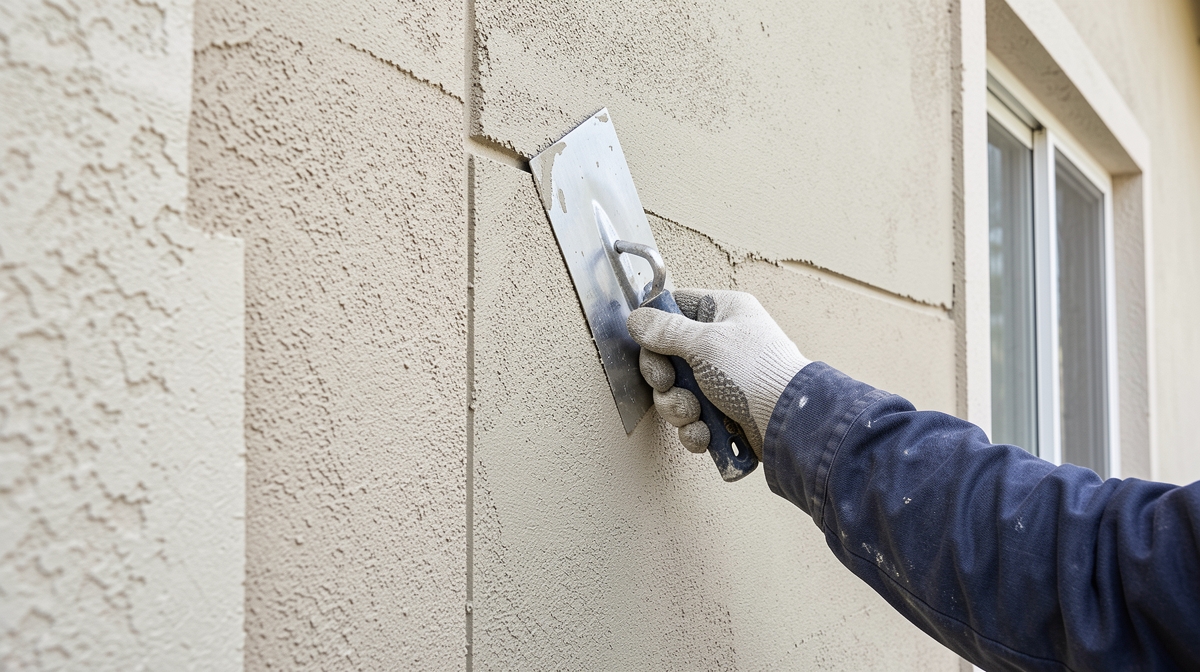
Stucco walls tend to tell you what’s happening behind them, but they say it quietly. A hairline crack near a window corner, a chalky white streak below a parapet, a patch that sounds hollow when you tap it — each one is a symptom, and each one gets harder to fix once the rainy season starts pushing water at the wall for months at a time.
Portland cement stucco is a durable cladding, but it isn’t a watertight skin. It’s part of a system that includes a water-resistive barrier and flashing behind the finish, and when any part of that system is compromised, moisture can reach sheathing and framing where it does real damage. Catching the symptoms during the dry months gives a repair the conditions it needs: cement plaster has documented temperature limits, multi-day moist-cure requirements, and long waits before some finishes can go on.
Here are the warning signs worth walking your building for now, what each one usually means, and when it’s time to bring in a professional rather than reach for a tube of caulk.
Cracks That Are Widening, Patterned, or Concentrated at Corners
Some degree of cracking is normal in Portland cement stucco and generally isn’t a material defect. Fine, stable hairline cracks are often cosmetic. The cracks that deserve attention behave differently:
- Diagonal cracks radiating from window and door corners — classic stress points, and common spots where reinforcing mesh gets skipped during original installation
- Cracks that have visibly widened since you last looked, or that you can slip a fingernail into
- Map-pattern or laddered cracking across a whole elevation, which can point to mix, curing, or lath problems rather than a single stress point
Why it matters: an open crack is a water path. During a Bay Area dry summer it mostly collects dust. Once winter rains arrive, wind-driven water can work through it repeatedly, and what starts as a surface symptom can become saturated paper and sheathing behind the finish. One honest note on repairs: obtaining a perfect color and texture match is very difficult, and an isolated crack repair, while effective functionally, may stand out from the rest of the wall. A pro can walk you through options for blending or refinishing so the fix protects the wall without becoming the new eyesore.
White Chalky Streaks and Persistent Staining
Efflorescence is the migration of soluble salts in Portland cement materials to the surface. It happens when water gets into the material, dissolves compounds inside, and carries them to the face of the wall, where the water evaporates and leaves the salts behind. The white residue itself brushes off easily. The message it carries doesn’t: water is moving through that section of wall.
Pay attention to where the staining shows up. Streaks below parapet caps, window sills, and roof-to-wall intersections usually point at a flashing or drainage problem above the stain, not at the stucco where the stain appears. Dark, damp-looking patches that linger long after a wall should have dried are a similar red flag. If efflorescence or staining keeps returning after cleaning, that’s the point where a professional should trace the water source — leak detection is diagnostic work, and treating only the visible stain leaves the actual entry point open for another winter.
Hollow Sounds, Bulges, and Soft Spots
This is the symptom you find with your knuckles, not your eyes. Tap across a wall and listen for a change in sound. Well-bonded stucco sounds solid; delaminated stucco sounds hollow. Repair specifications call for defining the repair area based on sounding, removing stucco to sound substrate, and extending repairs laterally to adjacent well-bonded material — which is why a hollow patch the size of a dinner plate can honestly become a repair area twice that size once the loose material is opened up.
Watch for these related signs:
- Visible bulging or a wavy section on an otherwise flat wall, suggesting the stucco has separated from its lath
- Sections that flex or crumble under light pressure
- Loose chunks or spalling at the base of walls, around hose bibbs, or where sprinklers hit the building
Delaminated stucco calls for a pro sooner rather than later. Once bond is lost, gravity and moisture only move things in one direction, and a bulging panel over a walkway is a safety question as much as a maintenance one. On older North Bay homes, there’s an added wrinkle: historic lime-based stucco is a distinct material from modern Portland cement mixes, and repairing it is its own specialty. Age and deferred maintenance speed up deterioration on these buildings, so matching the original system matters.
Trouble at Flashing, Penetrations, and the Roofline
Some of the most consequential stucco failures aren’t in the field of the wall at all. They’re at the transitions — the places where stucco meets roofing, windows, decks, vents, and light fixtures. A proper repair verifies correct lapping of the water-resistive components and flashing behind the finish, because the paper and flashing are what actually manage the water the stucco lets through.
Signs worth checking before the rains:
- Gaps, cracked sealant, or separation where stucco meets window and door trim
- Rust streaks bleeding from lath, flashing, or fasteners
- Deterioration at kick-out locations where a roof edge dies into a wall — a spot that funnels enormous amounts of water in a storm
These details matter equally for a homeowner with one problem window and a GC or property manager looking at a whole elevation. Surface patching over a failed flashing detail hides the symptom while the leak continues, so anything at a transition point is worth a professional assessment before it’s covered up.
Why Cool, Wet Months Make These Repairs Harder to Schedule
The “before winter” logic isn’t sales pressure — it’s chemistry and code. Exterior Portland cement stucco is applied under ASTM C926, and the documented constraints stack up against cold, wet weather. Manufacturer specifications for cement stucco systems call for keeping ambient and surface temperatures above 40°F during application and the drying period, with supplementary heat required below that. Proprietary polymer-modified repair materials go further: they can’t be applied in freezing conditions, during precipitation, or when precipitation is imminent, and they follow their own manufacturer instructions rather than the field-mix rules.
Cure times add up too. Repair scratch and brown coats applied per ASTM C926 typically need moist curing for a minimum of 48 hours — covered with sheeting or fog-sprayed — and each coat has to set enough to support the next, with timing that varies by climate. If the repaired area will receive an acrylic or elastomeric finish, specifications commonly require around 28 days of brown-coat cure or a verified pH below 10 before standard primers and finishes go on.
Walk the Building Now, Repair on Your Terms
A slow lap around the building with your eyes and knuckles costs nothing and tells you a lot: cracks at corners, white streaks, hollow spots, tired flashing details. Finding those symptoms during dry weather means the repair can be scoped calmly, cured properly, and finished to spec — instead of diagnosed through a ceiling stain in the middle of a storm. Small openings in a stucco system rarely stay small once water starts cycling through them, and repair guides themselves acknowledge that when conditions are in doubt, a qualified professional should diagnose the wall and develop the repair strategy.
If your walls are showing any of these warning signs, One Stop Plastering handles residential and commercial exterior stucco repairs, meshing, waterproofing, and leak detection throughout the Northern San Francisco Bay Area — contact us for a stucco repair estimate and get the wall assessed while the weather is still on your side.