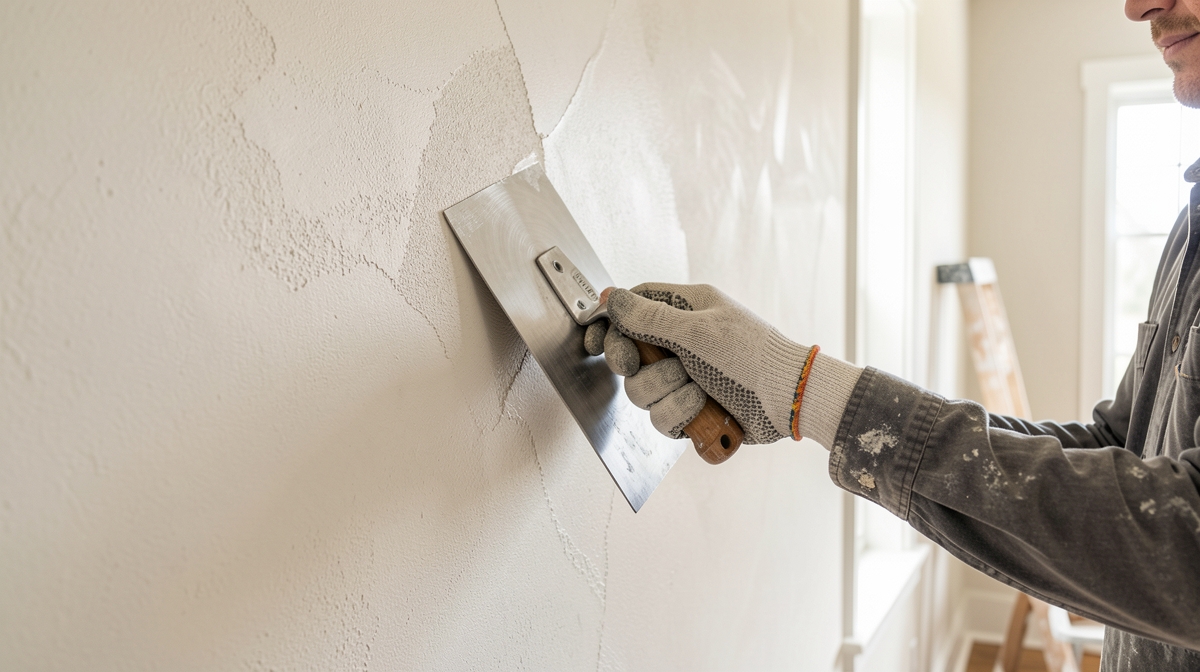
A polished lime wall in a Marina flat or a Mill Valley living room does something paint never quite manages: it holds light. That depth comes from real material — lime and finely crushed marble, worked in thin layers by hand. Venetian plaster is the common name for this family of finishes, made famous in northern Italy during the Renaissance, and it has found a comfortable home in the Bay Area’s older housing stock and newer custom builds alike.
But the term covers more than one finish, and the two most talked-about — Marmorino and Stucco Lustro — behave differently on the wall, cost different amounts of labor, and reward different kinds of care. Add San Francisco’s fog, coastal humidity, and winter rains, and choosing between them becomes a practical decision, not just an aesthetic one.
This article puts the two finishes side by side, covers how each holds up in a damp coastal climate, and lays out the care habits that keep either one looking right for decades.
What Venetian Plaster in San Francisco Actually Involves
Venetian plaster describes a range of naturally pigmented, durable finishes made using lime and finely crushed marble. Its roots go back to Ancient Egypt, Greece, and Rome, but Renaissance Venice made it famous — hence the name. The important point for a homeowner: this is an interior decorative lime finish. It’s a different system from gypsum veneer plaster on the inside of a wall and a completely different system from exterior Portland-cement stucco. Care advice and timing rules for one don’t automatically transfer to another.
Proprietary versions vary too. Armourcoat’s Armuralia, for example, is made from superfine aged lime putty with more than 40 percent crushed recycled marble, polished to a mid-sheen surface. Oakland-based ArcusStone formulates its lime plaster from hydrated lime, fine-grain sand, and proprietary additives, and lists application over EIFS, stucco, sheetrock, cement board, and other substrates. Any care or timing question about a specific product should be answered by that maker’s data sheet — not a general rule of thumb.
One thing all lime finishes share: chemistry. Plaster mixtures containing hydrated lime are highly alkaline, with a pH of 13 or higher. That matters later if anyone plans to prime or paint over or near the finish, because the coating has to be alkali-resistant.
Marmorino: The Layered, Understated Option
Marmorino — Italian for “little marble” — is traditionally applied in three or four consecutive fine layers. The result reads as soft stone: subtle movement, gentle sheen, a surface that looks natural rather than showy. For many rooms it’s the more forgiving choice.
Where Marmorino tends to make sense:
- Larger wall fields — living rooms, stairwells, hallways — where a high-gloss surface would telegraph every framing wave and trowel pass.
- Rooms with strong, changing natural light, common in San Francisco’s fog-then-sun afternoons, where a matte-to-satin surface handles glare gracefully.
- Households that want character without babying the walls; a lower sheen is generally less revealing of scuffs and touch-ups.
Because it’s built in fewer layers than the high-gloss finishes, Marmorino usually involves less labor per square foot, though the substrate still has to be flat, sound, and properly prepared. A wavy wall under Marmorino is a mildly wavy wall; the finish softens flaws rather than magnifying them.
Stucco Lustro: The Polished Showpiece
Stucco Lustro — “polished lime” — is a semi-translucent, high-gloss finish made from aged lime putty and super-fine marble flour. It’s traditionally applied in four to six layers and hand-polished with a specialist trowel. This is the finish people picture when they imagine Venetian plaster glowing like marble: deep, glassy, and dramatic.
That drama comes with demands:
- More layers and hand-polishing mean more labor and a longer application window than Marmorino.
- A high-gloss surface reveals everything beneath it — substrate flatness and prep work have to be excellent.
- Working time is tight; lime-containing finish plasters set faster than most conventional plasters, so the applicator mixes only what can be worked before set begins. This is skilled-trades territory, not a weekend project.
Stucco Lustro rewards focused use: a fireplace surround, a dining room, an entry wall in a Pacific Heights Victorian. On the right wall, nothing else in the finish world quite matches it. On the wrong wall — a long, imperfect corridor under raking light — it can highlight every flaw the plasterer inherited.
How Fog, Humidity, and Winter Rain Affect Either Finish
Here’s a point that surprises people: for thin interior finish coats, the documented enemy isn’t slow drying — it’s drying too fast. USG’s guidance for interior gypsum and lime-containing veneer finishes calls for 60 to 70 °F during application (never below 55 °F, before, during, and after) with air circulation kept to a minimum until the coat dries. Finish coats go on thin, and if water leaves the plaster too quickly, the material can’t fully hydrate. The result is dryout — a weak, powdery surface — along with excessive shrinkage.
In other words, San Francisco’s mild, humid air is closer to friendly territory for thin lime finishes than a hot, dry inland climate would be. Even in a dry September stretch, the fix is simple: keep the room in the comfortable temperature band and don’t force-ventilate fresh work.
Ongoing moisture is the other side of the coin. Gypsum-based interior plaster systems are not recommended where contact with water or excessive moisture is expected, so any leak, condensation problem, or failing flashing behind a decorative wall needs to be found and fixed first — the finish is only as durable as the dry wall behind it. If plaster does get wet, industry guidance from the wall and ceiling trade says wet plaster doesn’t automatically require replacement.
For everyday care of either finish, stay gentle and stay away from acids. Manufacturer guidance for plaster surfaces is clear: never use vinegar-and-water solutions, which degrade the plaster and pit the surface. A slightly damp cloth to lift dust is the safe routine. For any product-specific sealer or cleaner, follow that finish maker’s data sheet, and evaluate a jobsite mock-up before decorating at scale.
Which Finish Is Right for Your Home?
If the goal is warmth across whole rooms, a forgiving surface, and a somewhat lighter labor scope, Marmorino is usually the stronger fit. If the goal is a jewel-box moment — one wall or one room with genuine depth and gloss — Stucco Lustro earns its extra layers, provided the substrate is dead flat and the room stays reasonably dry.
A few deciding questions worth answering before committing:
- How flat and sound is the existing wall, and what prep will it take to get there?
- Does the room see steady moisture — a bath, a wall with a history of leaks — that needs correcting first?
- Do you want the finish to whisper across the whole space or make one statement wall?
There’s no single best answer; the right finish depends on the wall, the light, and how the room is used.
Plan Venetian Plaster Work With Realistic Expectations
Venetian plaster rewards patience at every stage. The material sets quickly on the trowel, but decoration readiness depends on ambient conditions and should be verified — not assumed — and whole-project schedules depend on scope, substrate prep, product instructions, and site conditions.
One Stop Plastering, a licensed (California contractor license 973914), bonded, and insured company, provides Venetian plaster and other residential and commercial plaster and stucco services throughout the Northern San Francisco Bay Area — reach out to talk through which finish fits your walls.